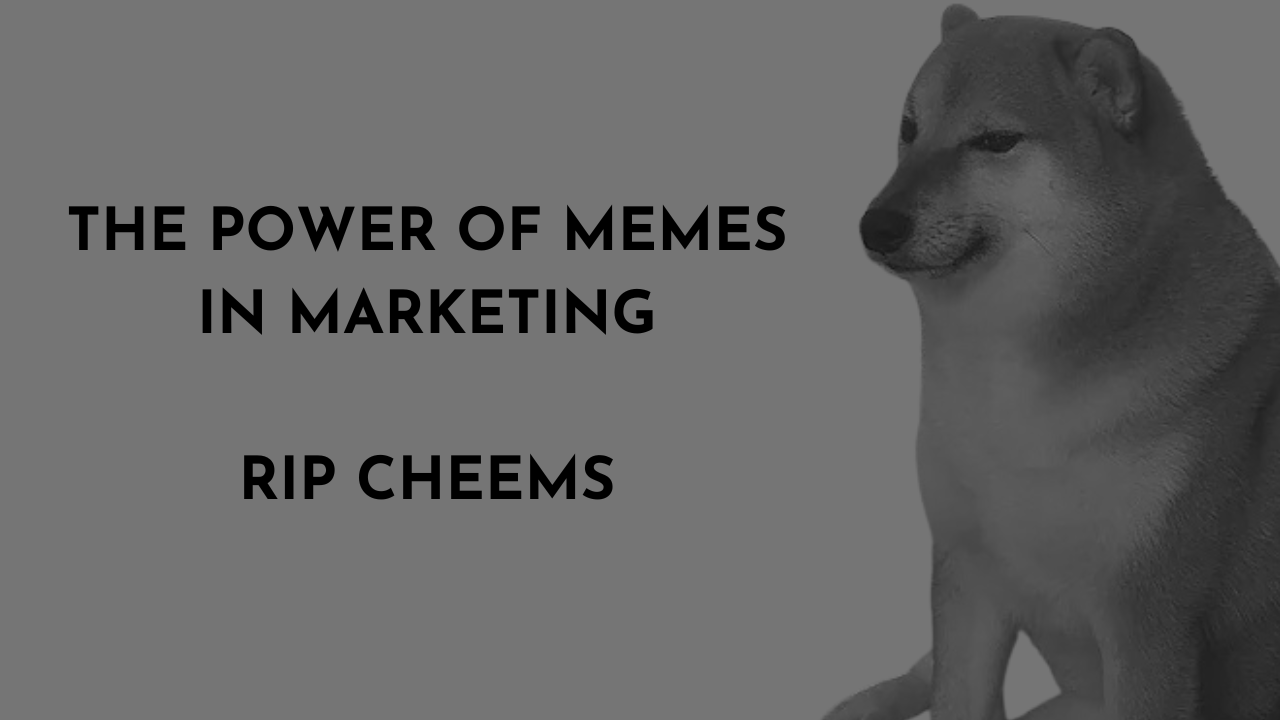
Balltze, better known as Cheems, died a few days ago. While it’s always sad when an animal dies, it’s probably the first time when one so strongly associated with memes (while it was alive) has passed away. We’re obviously not counting Harambe in, as he became a meme posthumously. This situation and the reaction of the internet community reminded me of how mighty memes can be in communications (and how they can also be misused) and I’d like to talk a bit about two huge reasons regarding that matter.
Cultural relatability
SoMe communication should, for the most part, be fun for the recipient. Aside from some small exceptions, people use these platforms to connect with friends and to chill and have a laugh here and there. Memes work phenomenally for that purpose, as they provide some sort of a backbone that provides backing context to a piece of content. They also (usually) brim with positive connotations and are quite accessible.

Some memes overstay their welcome and become disliked over time – as was the case when the doge memes faded away from fashion back in 2013/2014 before making a return in a new form. However, what Cheems, or rather the content creators have achieved, was the remix ability of the meme itself. It was just a funny dog picture and it could be fit into many scenarios. Since it started off in its original form in 2020, it has evolved at least twice into the form of the “horny jail” dog meme and the Chad Doge vs Cheems meme, the latter of which was a spin on the virgin vs chad meme. It’s almost unheard of for a meme to be relevant for such a long time. While it never was the biggest thing out there, let’s compare the interest graphs between it and Dat Boi, which took the internet by storm back in 2016. Dat Boi lasted for around 16 months since dying out, while Cheems, despite reaching only 13% of the popularity of Dat Boi at its peak, has been steadily used for more than 3 years at this point.

The longevity and versatility of Cheems could be a result of many factors, however, I’d like to point two out:
- Remix culture – according to Wikipedia, it’s the culture nowadays, where people are encouraged to take the original piece of content and are praised and even encouraged to make a derivative of it; memes (gathering tonnes of likes on social media) are one of the best examples of this phenomenon.
- The ease of making UGC nowadays – you don’t need any graphical prowess to make a meme. All that is needed is a template, a meme generator or even MS Paint and you’re good to go with your wit and humour.


Cheems fit perfectly into the remix culture aspect, and while being so versatile, people found it really easy to create new, fresh, relatable and varied content with the dog. Now, the second reason.
It’s (usually) free and popular IP
Imagine being able to freely use a massively popular IP in your communications without restrictions. That would be advantageous even for the industry giants, not to mention indie studios. Obviously, in the real world, this would land you with, at the very best, a cease and desist letter from the IP rightsholder. After all, plastering the Lamborghini emblem over your small racing game would make, in the eyes of the rightsholder, for depreciating the value of the brand.
Thinking of it, all these massive, mainline culture brands like Coca-Cola, BMW and Nike are all memes. Not in the sense of them being associated with funny internet pictures, but in the academic sense of the term. According to Wikipedia:
“A meme is an idea, behavior, or style that spreads by means of imitation from person to person within a culture and often carries symbolic meaning representing a particular phenomenon or theme. A meme acts as a unit for carrying cultural ideas, symbols, or practices, that can be transmitted from one mind to another through writing, speech, gestures, rituals, or other imitable phenomena with a mimicked theme.”
Now look at these three images and you’ll immediately associate them with a brand – which, by this definition is a meme.

I believe that, under some circumstances, the words “meme” and “intellectual property” (such as branding) can be used interchangeably. And even though we can’t plaster the IP-meme of the UFC on our fighting game, we could use Cheems to do the work for us.
In this way, we get a powerful IP-meme that’s well-known and associated with positive things and a specific set of applications and implications. The term “IP” applies less to a meme than “meme” applies to an IP, as IPs are often secured by sets of legal regulations, while memes (funny internet pictures) are not (with the huge exceptions of the trollface and rage comics). This is way more complicated than that, as memes theoretically are protected by IP law regulations, but they aren’t trademarks, yatta yatta yatta.
The important thing is that you can almost always use a meme to liven up your communication. If it’s good and people are genuinely amused by it, it can create a more positive reception of your brand and make it more relatable. It’s easy to make a bad meme, though, so keep that in mind.
Conclusion
There is definitely more to memes than I mentioned in the article. I wouldn’t be surprised if there were academic papers on that matter. However, that’s all that I’m gonna cover in this entry. If you need someone to take care of your game’s social media communications, pop an email to jakub@heapsagency.com and let’s have a chat about it.
Thanks for reading. I post weekly, so see you on the upcoming Monday. Cheers!
RIP Cheems, thank you for bringing so many smiles to the world over these last 3 years.
 Heaps Agency