
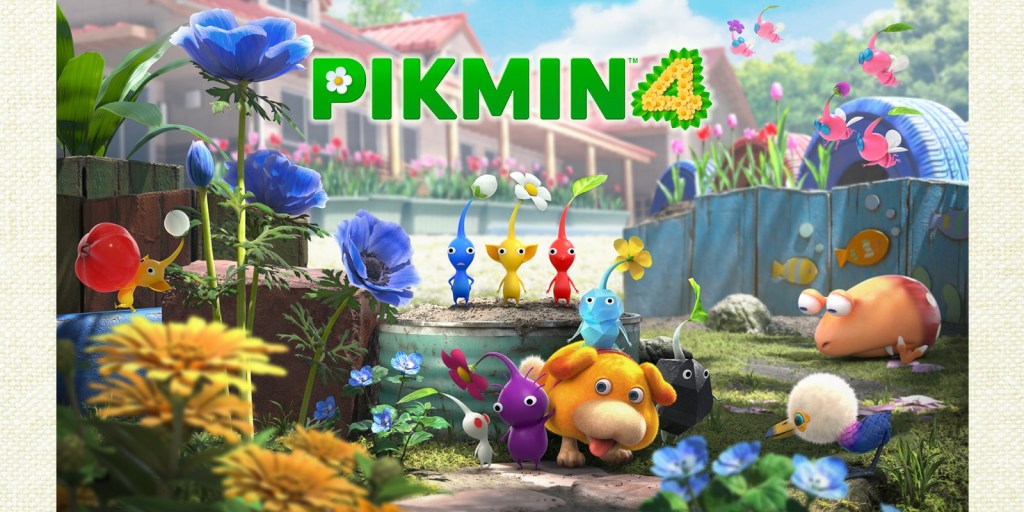
Pikmin is an odd series. Long story short, you, represented by Olimar – a spaceship captain – need to steer sentient aliens that seem a bit like radishes (yeah) through a series of maps. It’s a combination of a strategy and a puzzle game. The first Pikmin game was released on the Gamecube in 2001 and the latest in the series, Pikmin 4, was released 3 days ago, on the 21st of January. Even though it’s a 1st party Nintendo franchise, which usually does wonders for the strength and sales of the IP, it’s not exactly flying off the shelves. Shigeru Miyamoto believes that the lack of sales and popularity may result from the fact that it’s an RTS and that, while most such games don’t put a lot of emphasis on the conservation of your units, Pikmin does. I think there’s more to that, though and I’ll present my theories in this article.
The genre combo
RTS games are, unfortunately, a dying breed. Long gone are the days of Warcraft and Starcraft games, with the latest mainline entry of each game (not counting the “remaster” of Warcraft 3) coming out respectively in 2002 and 2010. The other titles that have made any significant impact on the industry in the last years? Age of Empires 4 was released in 2021.
There’s been a shift in what the industry delivers to the playerbase over the last few years. When people talk about “strategy games” nowadays, they usually refer to these two:
- grand strategy games like the Civilization series or many Paradox interactive games, like Crusader Kings or Hearts Of Iron series,
- tactical RPGs which have apparently entered a small renaissance of sorts, with both new releases (like Triangle Strategy or the new Fire Emblem) and remasters (like Battle Ogre) being delivered to the market (anyone hoping for Bahamut Lagoon’s 2D0HD remaster?).
I know there are also city-building games, but I consider them to be a different lot, thus not including them in this shortlist.
Then there’s also the puzzle aspect of the game. While puzzle games have been doing as well as ever, they are often not associated with the mainstream, or rather the AAA segment – maybe aside from Tetris and Arkanoid.
The closest franchise I could think of that’s similar – at least in concept – to the Pimin series and reached mainstream status is Lemmings. However, it’s an old and abandoned franchise at this point. There’s not much like Pikmin on the market, thus there doesn’t seem to be much of a niche. Or at least it’s so underexploited and obscure that most people who hear about the concept go “huh” and move on to something they’re more familiar with.
The platform mismatch and Nintendo’s exclusivity
Nintendo leverages their 1st party IPs almost since they came into the industry. This is a nice way of saying that in order to play their games in a legitimate way, you are most often forced to play them on their hardware. While it’s not an uncommon strategy – look at the Gran Turismo series for the PS – and it usually works (look at the newest Zelda and Mario Odyssey sales figures), it isn’t great for Pikmin.
Consoles, while they have had a fair share of RTS releases over the years (I recall playing C&C Red Alert on PSX), have never been considered the best platform for such games. It’s always been the PC with its mouse and keyboard interface that’s been considered the best in this case. Not much of a surprise, due to the heavy use of cursor and often complex menus. Gamepads are often not precise and not customisable enough to allow playing such games as well as it gets. And why would anyone want to play a game in a suboptimal way?
My theory is that Pikmin would perform way better in terms of sales if the games got ported to PCs. That’s extremely unlikely to happen, though, due to Nintendo’s policies regarding the use of their IPs.
Lack of an established presence due to consoles
There are 4 Pikmin games, aside from the remasters:
- Pikmin 1 came out on Gamecube,
- Pikmin 2 came out on Wii,
- Pikmin 3 came out on Wii U,
- Pikmin 4 has just come out on the Switch.
Gamecube was an underachiever in that generation of consoles – losing (in terms of unit sales) not only to the absolute industry juggernaut that was PS2 but also to the original Xbox, a newcomer to the scene. Wii U was a blunder in terms of performance (comparable to the already waning PS3 and X360 in 2012), branding and sales.
This means that the first Pikmin game wasn’t present on a console that made a huge impact on the market. The third game was also released on a console that managed to sell about 4 million units more than the Dreamcast and wasn’t even forgotten per se, as it was ignored from the very beginning. What about Pikmin 2? Wii sold great in Japan and well in other countries, but the console was rather pitched to be a pastime for families and strongly relied on multiplayer capabilities. Pikmin doesn’t suit that perceived image very well as a puzzle RTS. Suffice it to say, Pikmin 3 sold the best out of them all and it was only after the release of the game on the Switch that it managed to sell over 2 million copies.
I believe that Pikmin is still a relatively unknown franchise in the market and maybe Pikmin 4 will become a widely recognizable title that Nintendo wants it to be. Weird to think that a series that’s been on the market for 22 years is still trying to establish itself, but this may very well be the case.
Underdeveloped influencer scene
Due to the combination of reasons listed above, Pikmin, lightly put, isn’t the first choice of many influencers to cover. It’s a simple cause-and-effect chain.
Developers don’t make such games > people don’t play such games > aside from niche and die-hard fans there isn’t much of a community there > there aren’t any huge Pikmin influencers and brand ambassadors.
The fact that prior to the re-releases of Pikmin 1, 2 and 3 on the Switch there were few ways to stream these titles comfortably didn’t help at all.
Conclusion
Shigeru Miyamoto pointed out one of the reasons that the Pikmin series has been underselling. He’s probably aware of the other ones, but wouldn’t share them in a public interview due to Nintendo’s image. He believes that the series has a huge potential to become something that’s desired by the market. I think that it does have the quality, unique style to appeal to more players, but I don’t see it becoming a massive industry hit. It’s:
- one of its kind, to its detriment,
- not yet established well,
- wasn’t present on many prominent consoles,
- hampered by the 1st party Nintendo policies,
- probably better played with a mouse and keyboard,
- lacking in terms of community development.
If Nintendo manages to tackle at least some of the issues, I could see the series being at least maintained for their future consoles, if not expanded. A huge hit? No. A niche long-seller? Certainly. Hoping for the best for the franchise, as it’s nice to have something so unique on the market.
 Heaps Agency